What Football means to Italy!

They’ve won again. The Italians have won again, 31 games unbeaten. Unlike the group campaign, Italy didn’t play exhilarating football. They didn’t wipe the floor with Austria. There was no sense of inevitability. Rather, Italy suffered and Austria made them. They were wound through the wringer, battered and bruised, and were often compelled to think of the unthinkable. Roberto Mancini’s side was approaching a slow death, until the glorious intervention of Federico Chiesa, who swiped his left foot and thrust Italy ahead. Minutes later, Matteo Pessina scored a second and had Italy believing in destiny again. From London, the Italians are through. Three more and they are champions.
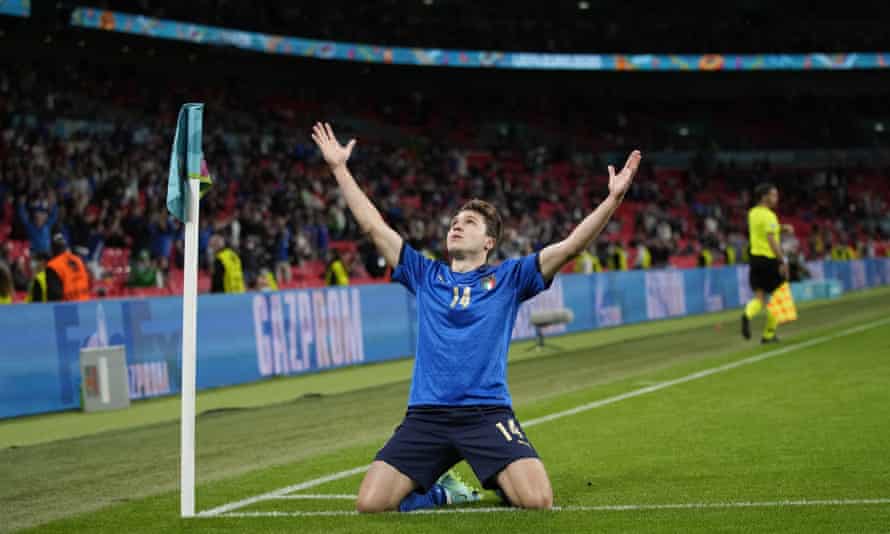
Federico Chiesa's extra-time missile makes Italy believe in miracles again  | Euro 2020 | The Guardian
Federico Chiesa, arms aloft as he gives Italy the lead

While Italy is unbeaten in 31, what’s Football really like in a country famous for art, fashion, gelato, pasta, Vespas, and hand gestures?

It’s a cliche but it holds true, Football in Italy is more than just a game. It’s a way of life. It doesn’t just start with a beer before kick-off and end with a ride home after full-time. It is inextricably woven into the very nature of Italian life, impacting every aspect of politics, economy, society, culture, and nationalism.

It is what makes a young girl grip her father’s fingers tighter in hope the penalty is converted. It is what makes teenage boys burden their ankles trying to emulate Roberto Baggio. It is what makes grown- adults with responsible jobs, lie awake in the middle of the night worrying about a local derby. It is what makes them go to work wearing silly necklaces and keyrings for supposed good luck. It is what makes a grandmother reminisce of her youth as a Caligari fan, crammed in a Roman bar to watch Italy at the World Cup while arguing with vegetable sellers and part-time waiters about referees. It is what makes Italy.
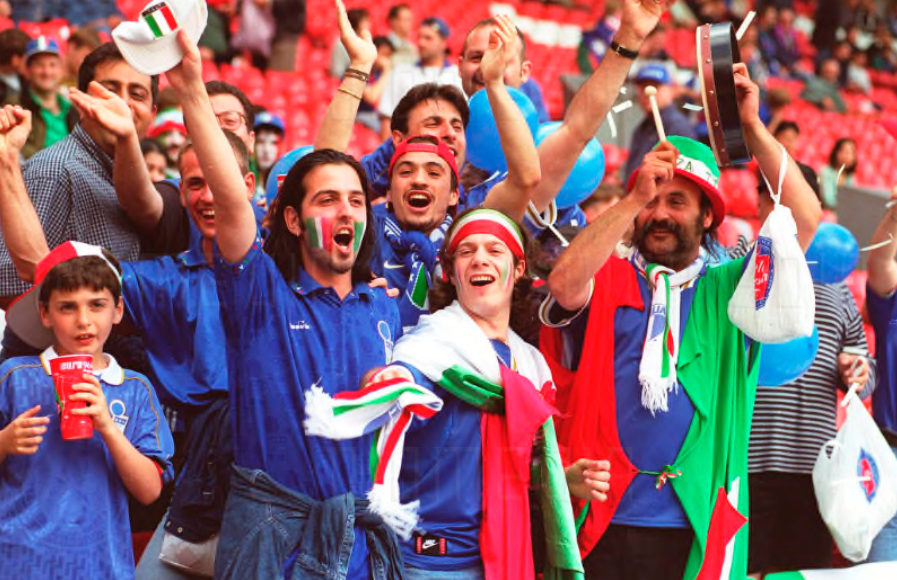
Italy has embraced Football from the ruins of British colonialism. Invigorated by the expats at the end of the 19th century, Italy has gone on to be a modern superpower in the most globalized game of all games. Through the ’90s, Italy was the hub of world football. It was home to players like Paolo Rossi, Roberto Baggio, and Paolo Maldini who commanded global stardom. Its domestic league, Serie-A, was by far the best in the world. But then 2006 happened, Italy was hit with a match-fixing scandal relinquishing the genuinity of the sacred game. Corruption and paranoia had infiltrated Football and every week there was a new conspiracy theory about bribes, match-fixing, bias, and cheating. It’s fair to say Italian Football since hasn’t hit the peaks it once did.

But that hasn’t affected the unwavering and religious support for the Italian national team. When Fabio Grosso scored the penalty to give Italy their 4th World Cup in 2006, 2 years of rumors and conspiracies were momentarily forgotten for the Italians to remind themselves why they love this game.

From Rick Steves‘ Italian travels and his understanding of Football in Italy, Roberto and Manfredo, two Italian natives were quoted commenting on the country’s football culture. Roberto says, “For Italy in the ’60s, opium was the religion to the masses.. Marx got it backward. Today, it is football“. Manfredo agrees and adds, “I read it in the newspaper, a cardinal said, ‘Football is the religion of Italy.’ Sunday is the only day for the family in Italy. And we spend it around the TV, watching football“.

It is a religion, a violent religion that gave rise to football hooliganism and violence through the ’70s and ’80s. It is a religion that is sometimes plagued by prejudice, stereotypes, and discrimination, till-date.

But oftentimes, Football is a source of personal and group identity, a discourse that gives fans a place and a voice, a home to abandoned citizens of the establishment, giving them a chance to be witnesses and participants. Young disenfranchised people betrayed by the state turn to football for a sense of national identity and pride. Football simply gives Italians, Italy. The Italy they love and treasure, through thick and thin.
The Fallacy of Ideology and Actuality

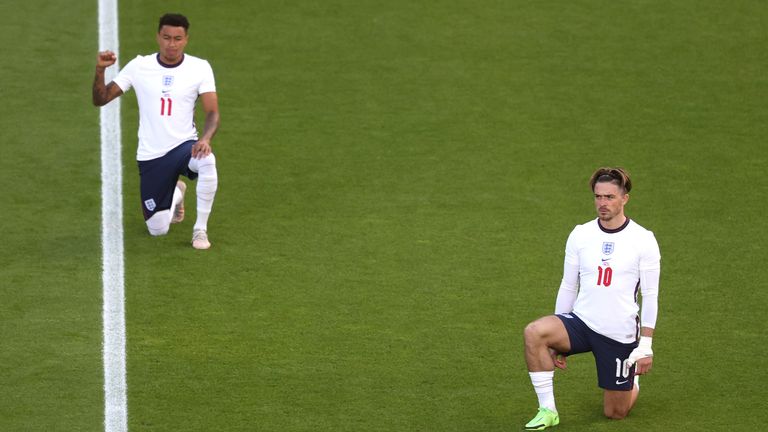
The players, Gareth Southgate, and the FA have time and again felt the need to reiterate that they are indeed fighting against racial inequality, injustice and discrimination. That taking the knee is not aligned with a political organization or ideology. That Black Lives Matter is a movement that is adopted to shed light on the institutional, structural and systemic racism that plagues black lives all over the world. Despite their attempts to make their position clear, players have continually been booed every time they take the knee.

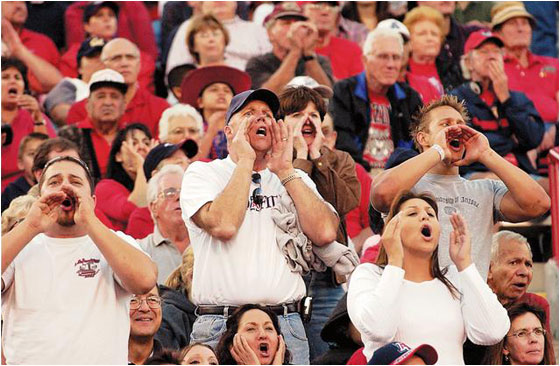
more booing at the Met? - Intermezzo

So why are they booed?

Well the protestors of the protest, which include right-wing media, politicians and a considerable chunk of the match-going fans, seemingly think that by taking the knee, the players are showing their support for political goals of crushing capitalism, defunding the police and destroying the nuclear family. That by involving themselves with the Black Lives Matter movement, they are inherently drawing on values of the Marxist ideology. At first glance, this may seem puzzling and random. Why would Harry Kane want to overthrow the state that has rewarded and glorified him? Why would Raheem Sterling want to defund the police or why would Marcus Rashford destroy the nuclear family when he longed for it having been brought up by a single mother?

But upon deeper introspection, there is one thing to note. There is Black Lives Matter – the movement and Black Lives Matter – the organization. The organization was formed in 2013 in response to the acquittal of George Zimmerman, a neighborhood watch, who shot Trayvon Martin, an unarmed black teenager, in Florida. Alicia Garza, Patrisse Cullors and Opal Tometi are the three founders and they call themselves ‘radical Black organizers’. Garza in 2015, had declared herself as a ‘trained Marxist’.

Furthermore, one of the beliefs of the organization that drew wide criticism and now forms the substance of opposition towards Black Lives Matter – the movement is:

“We disrupt the Western-prescribed nuclear family structure requirement by supporting each other as extended families and ‘villages’ that collectively care for one another, especially our children, to the degree that mothers, parents, and children are comfortable.”

It essentially means they stand opposed to the idea of nuclear family (parents and their dependent children – a basic social unit) for the perceived reasons that the concept of family is an insidious invention of capitalism and that it is more conducive to fostering collectivism and conformity to facilitate production. The collectivism and conformity thereby leading to hegemony of authorities and institutions insinuating racist policies and practices in societies. Apart from the layer of racism, this belief carries an eerie resemblance to Marxism.

The Marxist perspective of the family remains critical and blunt. It is seen as performing ideological functions for capitalism, a unit of consumption one that teaches passive acceptance of hierarchy, and moreover family as an institution through which the rich pass down their riches to their children, thus reproducing inequality in class.

But the question remains, why do they boo the players?

To put it modestly, they simply refuse to differentiate between Black Lives Matter – the movement and Black Lives Matter – the organization. The criticism and opposition is based on the core assumption that the Black Lives Matter movement carries the same values as of the founders and the organization.

However, this couldn’t be farther from the truth. The movement did start from the organization but it simply outgrew its roots. It has grown and broadened its horizons dramatically following the murder of George Floyd. Many adopted the movement, few who identify themselves as Marxists, to empower their voices, to fight racism, police brutality, to bring justice, healing and freedom.

Gareth Southgate says England staff is "fully united" and continues to face  on their toes at Euro 2020 | Soccer information - The Rv Article

“Regardless of whatever the professed politics of people may be who are prominent in the movement, they don’t represent its breadth,” said Keeanga-Yamahtta Taylor, Princeton University African American Studies professor and author of “From #BlackLivesMatter to Black Liberation.”

“There are definitely socialists within the movement, as there have been in every single social movement in 20th century American history and today. But that does not make those socialist movements, it makes them mass movements,” she said. 

The movement is very different from the organization. One can take a knee in solidarity with those seeking racial equality, while not representing the organization. In any facet of life, the argument is made that a small number of bad guys don’t represent the wider goodwill of the larger public.

Moreover, in any protest against entrenched power, one tried and tested move of delegitimization by the powerful is to change the conversation from the normative evaluation of the demands of protest to the normative evaluation of the method of protest.

Don’t let the message get lost in the bickering of the higher powers that choose to decide when, how, and why one should protest. The very idea of a protest is civil disobedience, it is to raise awareness, to make people uncomfortable and confront the issue.

Why do we follow football clubs?

I hadn’t followed football until I was 12. 2010 world cup in South Africa was the first time I observed the fervor and frenzy of football and just how big the sport is. I distinctly remember South Africa, the supposed underdog, scoring the opening goal and the ever-articulate Peter Drury said ‘A goal for all of Africa’. I didn’t think of it much at the time, but I later realized it was a story of redemption, that Africa had never hosted a world cup, no African country had ever won the holy grail, and that African footballers migrate to Europe to have a career. That one goal from the unassuming left-foot of Tshabalala had an entire continent jumping for joy. It was then I realized the power of football, its more than just a game. And that is when it started.

Watch the goal here, its a belter!

I’ve often wondered why I follow Manchester United, why I stay up till 4 in the morning to watch 11 men – whom I don’t have any tangible affiliation with – kick a football, why a result on a Saturday can either spark or ruin my weekend, why I sing their songs, and why I’m inexplicably invested in this football club thousands of miles away.

I was brought up in Hyderabad, India. I have no familial connections with Manchester or England, which often is a major factor in choosing a football club. Sometimes I wonder if the fandom was because of my inherent need to associate with success, and Manchester United is the most successful club in England. However, the glory-hunter argument doesn’t fare too well when you look at the timeline I’ve been supporting Man Utd, they’ve hardly won anything. In fact, it has caused a great deal of pain. Perhaps it’s the hope I cling on to.

Other times, I consider myself a purist who’s been convinced by the history, traditions, values and mystique of this splendid club. The way they used to play football with style and precision or the incredible story of the 1958 Munich air disaster and how the club never gave in. These have been the constant conflicts in my head but through some literature study, I’ve arrived at a few probable factors as to why people tend to follow football clubs.

Friends or Family

Family and friends form one of the most important factors in an individual choosing a football club. Especially the homegrown fans, who at a very young age get taken to stadiums by their father, mother, grandfather, uncles etc. This gets ingrained in the kids and they only ever follow that club. Even if the kid doesn’t get the affiliation from the family, friends at school can also dictate the choice of football club either positively or negatively. This contributes to the socialization aspect of football fan culture, especially for people who support their hometown club.

A young kid being taken to a stadium for the first time.

Psychological factors

Psychological factors are inherent and have more to do with the individuals perceptions, feelings, values and beliefs. The identification with a football club arises from the need to be part of a community or achieve the sense of belonging. At the core, individuals either choose to support the successful teams to revel in the shared glory or they buck the trend and support an underdog or even an unsuccessful team to revel in the shared failure. The need for belonging is especially pertinent among the foreign consumers who love the sport and are desperate to be involved. The rise of social media has helped in this regard, turning fans from passive consumers into active creators.

Team-related factors

Factors such as attractiveness of a team’s play, performances, players involved, home stadium are commonly observed in the choices made by foreign consumers. The globalization of the game in the past 15 years with trans-national broadcast has really helped turn football players into global superstars who garner their own set of fans, cue Messi and Ronaldo. These set of fans tend to follow a football club only for the player and if the player moves to a different club, so do they.

people near green field using smartphones
Football is inevitable, the consumer is consumed.

All these factors are only stimulus to get started and once you do start following a football club, its not just a game anymore. It becomes a way of life, an integral part of your identity so much so that you spend money on purchasing merchandise to tell everybody around you what your football club is. It’s been proven to have an impact on the mental health of individuals depending on their teams performances. People derive psychological benefits, social connections, practice escapism and get lost in the chaos of all of it. Moreover, the game has a place for everybody, it can host angels and devils, geniuses and journeymen, boy-wonder and the veteran, favorites and underdogs. It is home to drama, stalemates, art, mistakes, ecstasy, tragedy, defiance and heart all in equal measures. After a certain point, football is no longer a choice, the consumer is consumed.

Design a site like this with WordPress.com
Get started